Strategic planning for nonprofit organizations: Best practices + examples

Strategic planning for a nonprofit refers to the process of designing a roadmap that defines where the organization is headed, the goals that will get it there, and the specific actions and resources required. It focuses on impact, balancing program outcomes and community accountability with financial sustainability.
Even the most mission-driven nonprofits can’t succeed based on their mission alone. Strategic planning for nonprofit organizations can take your mission from idealistic to impactful. This type of planning is the process by which an organization determines where it’s headed, how it’ll get there, and how to measure success, often leveraging nonprofit software.
Strategic planning for nonprofits is essential for aligning your programs, resources, and stakeholders in service of your mission. But you’ve got to do it right with a thoughtful, data-driven approach that engages the right stakeholders and decision-makers.
A strong first step is to leverage software like Bonterra, which helps you track trends, performance markers, and examples of your impact. This type of data-driven storytelling can help you develop a strong strategic plan that carries your organization into the future.
What is strategic planning for nonprofit organizations?
Strategic planning for a nonprofit is the process of designing a roadmap that defines where the organization is headed, the goals that will get it there, and the specific actions and resources required. Rather than a simple checklist, a strategic plan includes details about program outcomes, fundraising goals, governance, and operations.
While similar to that for businesses, strategic planning for public and nonprofit organizations has its own traits. Rather than emphasizing profit, nonprofit strategic planning focuses on impact, balancing program outcomes and community accountability with financial sustainability.
Typically, this means increased stakeholder engagement, such as with clients, funders, or community partners, and a greater focus on governance and tracking metrics related to mission impact, rather than just revenue.
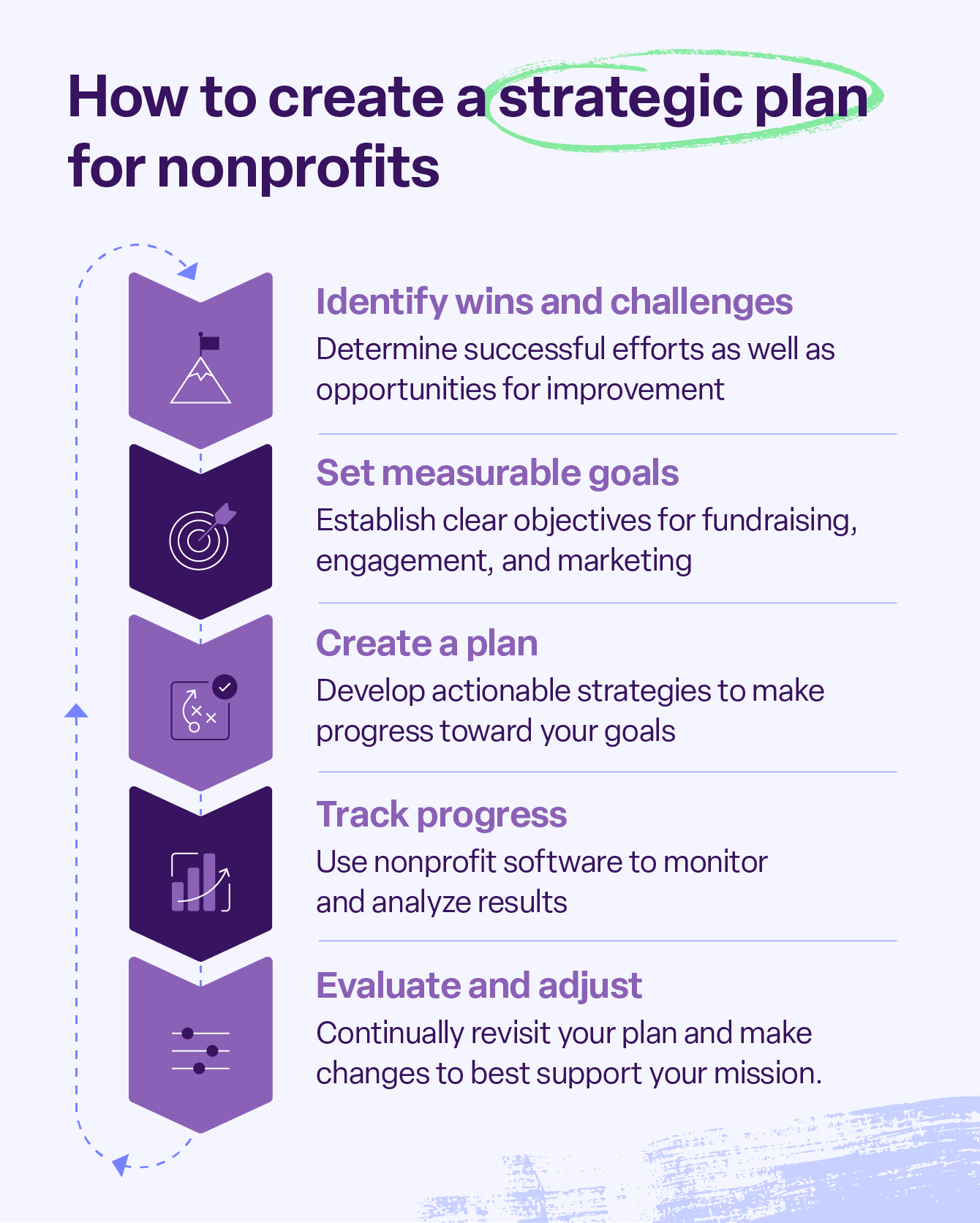
4 steps to create a strategic plan
To start building a strategic plan, you need the right data. When organizations implement software like Bonterra, it’s easy to keep track of important metrics through dashboards and reports, watching for any changes or anomalies throughout the year.
1. Conduct a situational analysis
The first step is conducting a situational analysis or needs assessment — a structured assessment of your organization’s internal capabilities and any external context. There are a few ways to do this, including SWOT and PEST analyses.
SWOT is a framework for assessing internal and external factors that influence your organization:
- Strengths: What your organization is doing well
- Weaknesses: Limitations or challenges
- Opportunities: External factors your organization can leverage
- Threats: External risks that may impact your success
The PEST framework covers a broader operating environment:
- Political: Policies, regulations, and political issues impacting your operations
- Economic: Market conditions, financial trends, employment rates, and inflation
- Social: Cultural trends, consumer behaviors, or demographics
- Technological: Tools, technology, and innovations that may influence your strategy
Pair these assessments with stakeholder interviews or focus groups with the board, staff, volunteers, or beneficiaries to get a full picture of opportunities and gaps. When you pull it all together, you should have a baseline for targets and any potential changes needed.
For instance, a nonprofit focused on youth development might discover through a SWOT analysis that its strength is high volunteer engagement, but a major weakness is limited fundraising capacity. The organization may identify local population growth as an opportunity, but a difficult economic market as a threat.
2. Define goals and objectives
Next, determine the goals and objectives you want to set in motion. These should be SMART goals, which are:
- Specific: Clearly defined and detailed
- Measurable: Trackable using concrete data or metrics
- Achievable: Realistic and attainable within your resources
- Relevant: In alignment with your mission and strategic vision
- Time-bound: Completed in a specific timeframe
Goals should include objectives related to both your impact and operations. It’s important that goals closely reflect your mission, values, and vision.
For example, a goal might be to increase the reach of your program by 25% while maintaining a 90% satisfaction rate by 2027. Or, a SMART fundraising goal might be to raise revenue by 10% and increase donor retention to 60% within the next 12 months.
3. Develop strategies and action plans
For each goal, document the strategy, approach, and actions to take. This includes mapping tasks to accountable owners, setting specific timelines, and understanding required resources.
Understanding these pieces before executing your strategy helps you determine exactly what you need for success, whether that’s delegating ownership to employees or removing major blockers. Be sure that as much as possible is measurable — you want to be able to check on your milestones at least quarterly.
If, for instance, an organization wanted to grow monthly giving, a strategy might be launching a recurring donor program. Actions might include creating new donor tiers, assigning stewardship tasks to development staff, and rolling out an email campaign by Q4.
4. Measure your impact
To measure the impact of your strategy, define the metrics you’ll track. Consider somewhere between four and eight KPIs, which can be a mix of output, outcome, and operational milestones. Examples include:
- Number of recipients served
- Outcome changes
- Donor retention rate
- Revenue
- Program completion rates
Set a regular cadence, such as monthly or quarterly, to review and assess. Use this data to test your assumptions and get a clear view into what is and is not working as expected. Bonterra’s reporting and data tools simplify this process, so you can view all your data in one place and get a clear picture of exactly what’s going on.
A shelter for the unhoused might track KPIs like the average length of stay, completion rates for counseling sessions or meetings to discuss services, and the percentage of clients who secure housing within six months.
Strategic planning for nonprofit organizations template
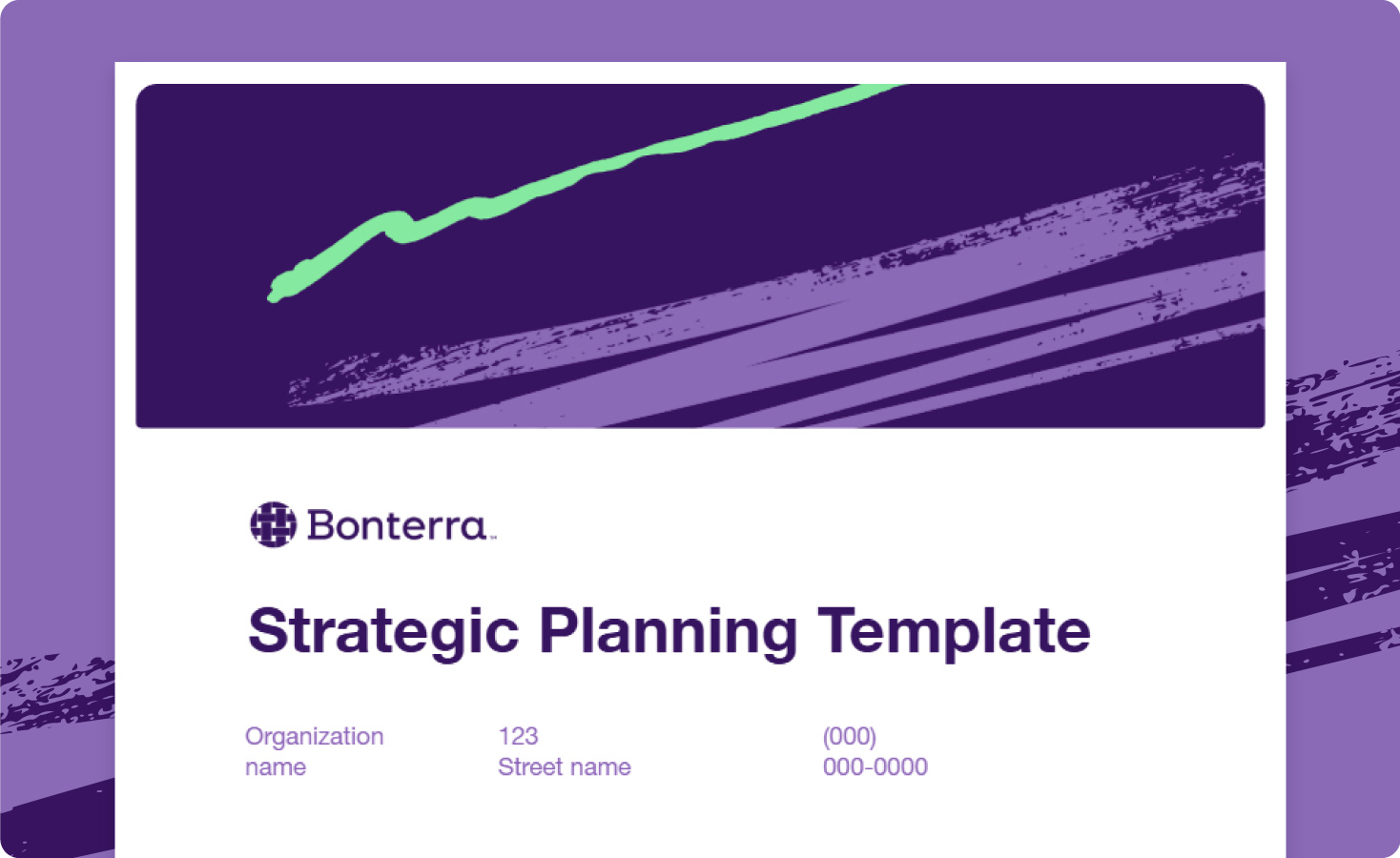
A strategic plan should be a living document, meaning you should revisit it regularly and iterate as needed. Ideally, you should include your organization’s mission and vision, situational analysis details, your priorities and SMART goals, and an action plan including resources, owners, and timelines.
Below is a strategic planning template that includes all of the above details. Consider linking directly to your data sources for each KPI, as well as to any other relevant information like project documentation or plans.
Real examples of nonprofit strategic planning in action
It can help to see strategic planning in action. Below, we’ll walk through some real-life nonprofit strategic plan examples.
National Wildlife Refuge Association
The National Wildlife Refuge Association (NWRA) has spent over 50 years advocating to protect and grow wildlife refuges across the United States.
Challenge: When NWRA faced reduced federal funding and the increasing threat of climate change and development, the organization needed to come up with a more strategic approach to advance its mission.
Solution: To do this, NWRA created a partnership-focused strategy that covered education, advocacy, and collaboration. The plan focused on growing awareness of the benefits of refuges as well as cultivating stronger partnerships with government agencies, communities, and other organizations.
A key piece of the plan’s success was the use of data and technology through Bonterra EveryAction’s features.
The results: The plan helped improve donor engagement, keep track of contributions, and streamline donor and community outreach, allowing NWRA to scale fundraising and advocacy efforts without adding staff.
Hopecam
Hopecam connects children with cancer to their communities and classrooms during treatment, giving them a way to participate while staying safe.
Challenge: Hopecam needed to modernize its systems to better serve families and raise more funds. With a small team, the outdated databases were disorganized, slow, and made tracking data difficult.
Solution: To address this, Hopecam leveraged Bonterra’s Network for Good and Apricot solutions, which provided a unified, modern system to manage both fundraising and client operations.
The results: Hopecam launched its most ambitious fundraising effort, raising over $500,000. Other successes included saving 15 hours per week through automation and reporting, increasing donor retention by 10%, and bringing in $31,000 in sponsorships.
Angels Over Cliffs
Angels Over Cliffs is a human services organization that serves individuals experiencing homelessness and addiction, helping them access resources and treatment.
Challenge: Early on, the founders relied on paper files and handwritten notes to keep track of donors and outreach, but that quickly proved inefficient and difficult to manage. Looking toward larger fundraising activities and grant applications, they realized they needed a better system to help scale the organization.
Solution: A big part of this strategy was to implement software — Bonterra EveryAction — that could support donor tracking, email marketing, online giving, and event management.
The results: This let the founders replace manual work with a streamlined, centralized system. Plus, they were able to create a stronger event strategy by leveraging EveryAction for ticketing and mobile donations. The organization ultimately tripled its donor base, generated over $45,000 in donations, and received 74% of 2024’s recurring donor commitments in the first half of 2025.
Best practices for successful strategic planning
Strategic planning works best when it’s data-driven, inclusive, and operationalized. Here are a few strategic planning best practices:
- Inclusively engage stakeholders: Collect feedback from staff, volunteers, board members, community partners, donors, and beneficiaries.
- Turn goals into action plans: Detail specific actions, owners, timelines, and budgets for the goals you set.
- Review your plan regularly: Set time monthly or quarterly to review dashboards and reports.
- Focus on data quality: The best reports and dashboards rely on good data input, so be sure you’re using clean, accurate, and timely data.
- Be flexible: Conduct scenario planning so you have an idea of how to handle funding changes or policy updates.
- Invest in infrastructure: A robust nonprofit CRM, donor management system, or program database can help streamline your operations and outreach.
Data-driven nonprofit strategic planning with Bonterra
Strategic planning for nonprofit organizations requires knowing where your organization is, where you hope to go, and how to get there. Bonterra helps you centralize and streamline data so your strategy is informed by evidence and experience.
With this detailed data in hand, you can make sense of how to optimize fundraising, understand cost per service, and craft grant application narratives and impact stories. Use Bonterra’s tools to track the success of your strategic plan over time, so you always know where your strategy stands and how you can make it more impactful.
Ready to learn how Bonterra can help you tell your nonprofit impact story? Check out our nonprofit CRM today.

FAQ
How do I write a strategic plan for a nonprofit organization?
To write a strategic plan for a nonprofit organization, start by running a situational analysis, like SWOT or stakeholder interviews. Then select your top priorities and create relevant goals and action plans to achieve them. To measure success, select KPIs, like increased revenue or higher donor conversions, and implement regular reviews.
What are the 5 P’s of strategic planning?
There are two common examples of the 5 P’s of strategic planning. One is Mintzberg’s five Ps:
- Plan: A deliberate course of action
- Ploy: Tactics to address challenges or beat competition
- Pattern: Behaviors or actions that are consistent over time
- Position: How you differentiate yourself as an organization
- Perspective: The mindset or worldview guiding the organization
The other common example includes:
- Plan: A roadmap detailing where your organization is heading
- People: Staff, stakeholders, and communities involved
- Purpose: The “why” behind the work
- Priorities: What matters most for near-term focus
- Performance: How you measure and evaluate success
What should a nonprofit strategic plan include?
A nonprofit strategic plan should include:
- Documentation of your mission and vision
- Situational analysis summaries
- Strategic priorities and SMART goals
- Action plans, including owners, timelines, and resources
- Metrics and reporting schedule
- Contingency plans
What’s the 33% rule for nonprofits?
The 33% rule for nonprofits dictates that nonprofit organizations should keep their administration and overhead costs to approximately one-third (or 33%) of their total expenses. This means the other two-thirds of expenses go to programs. While this is a commonly cited rule, it’s not an actual requirement and won’t apply to all organizations.



Work with Bonterra
Ready to drive more impact?