Are you reporting what funders really want?

Funders aren’t short on reports. What they’re short on is clarity.
Every year, nonprofits submit pages of metrics, charts, and narratives meant to demonstrate impact and support nonprofit impact reporting. Yet many funders still walk away unsure, not because the work isn’t meaningful, but because the reporting doesn’t fully align with the questions they’re actually asking.
Over the past few years, funders have been clear about what they want to see: credible proof that their dollars are driving real, lasting change. That expectation hasn’t gone away. If anything, it’s intensified. As funding becomes more competitive and programs more complex, impact reporting has quietly become a signal of how ready an organization is to steward investment and scale outcomes.
So the real question isn’t whether you’re reporting. It’s whether your reporting reflects what funders truly need to understand.
Funders don’t want more data. They want better answers from impact measurement and evaluation.
In our earlier work exploring what funders really want, one theme came through clearly: funders are no longer approaching their role as passive donors. They’re making decisions more like investors, looking for evidence that resources are producing real, measurable change.
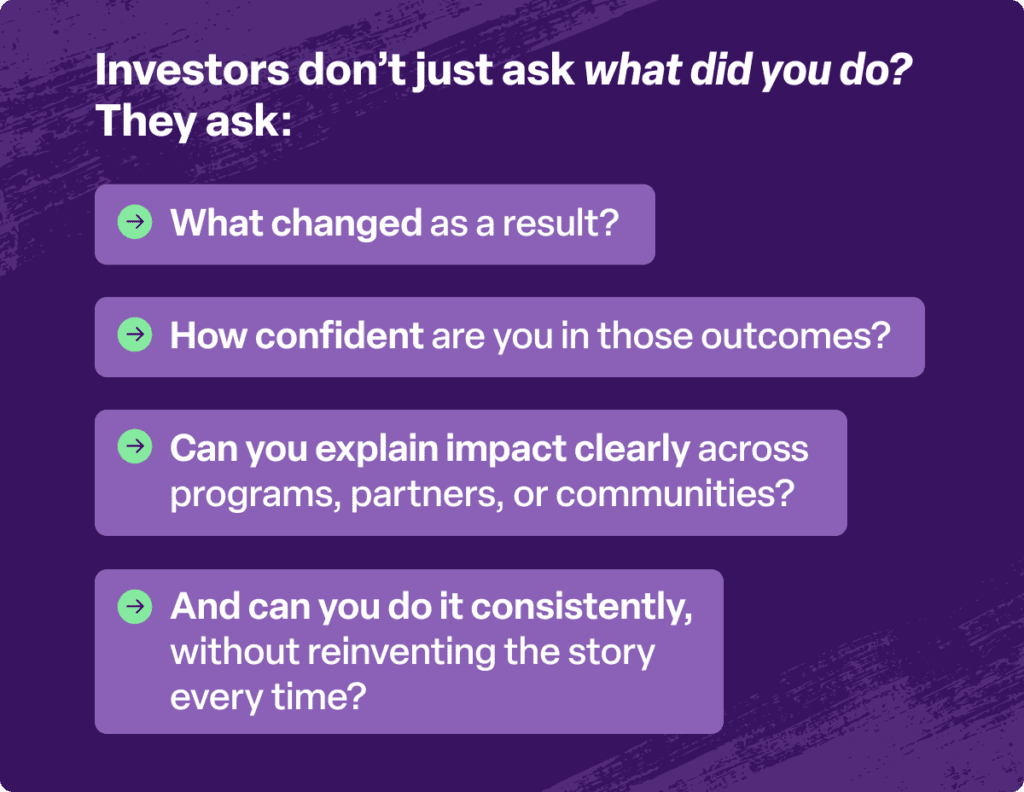
As a result, the conversation has shifted. Funders aren’t just interested in what was delivered, they’re focused on what changed, how confident an organization is in those outcomes, and whether impact can be explained clearly and consistently across programs, partners, or communities.
This is where many well-intentioned reports fall short. They focus heavily on outputs, services delivered, participants served, activities completed but struggle to translate those efforts into outcomes funders can evaluate, compare, and trust.
Outputs still matter. They provide essential context. But on their own, they don’t show progress.
What funders look for in strong nonprofit impact reporting
Across funder conversations, surveys, and real-world grant decisions, a few expectations show repeatedly.
1. Clear outcomes, not just activity
Funders want to understand what improved, stabilized, or changed for the people or communities served. They’re looking for evidence of progress, behavioral, economic, social, or environmental not just confirmation that a program ran as planned.
Strong reporting connects the dots between action and result, grounding decisions in measuring nonprofit impact rather than activity alone.
2. Consistency across programs and partners
As more funding flows to collaboratives, networks, and multi-partner initiatives, funders need a way to understand impact at both the program level and the collective level.
Fragmented reporting makes this nearly impossible, especially when funder reporting requirements vary across programs and partners. When every partner measures differently or reports in isolation, funders are left stitching together a story that should already be coherent.
3. Credibility and transparency
Funders understand that social change is complex. They’re not expecting perfection. What they are expecting is honesty, methodological consistency, and confidence in the data being presented.
When reporting feels improvised or overly manual, trust erodes, even if outcomes are strong.
4. Speed and accessibility
Impact reporting can no longer take months to assemble. Funders increasingly expect timely insights, clear visuals, and the ability to ask follow-up questions without waiting for another reporting cycle.
Slow reporting signals operational strain. Clear, responsive reporting signals readiness.
Why impact reporting breaks down as organizations grow
Many nonprofits don’t struggle with reporting because they lack commitment or rigor. More often, reporting becomes difficult because the scale and complexity of the work have outgrown the systems originally put in place to support it.
As organizations grow, a few predictable shifts tend to occur:
- Programs multiply
- Funding sources diversify
- Partnerships expand
- Reporting requirements diverge
Tools that once felt sufficient, such as static reports, spreadsheets, and manual data pulls begin to strain under that complexity. Teams spend more time reconciling data than learning from it. Administrators become intermediaries for every question. Program leaders wait on answers they need in real time to make decisions.
From a funder’s perspective, none of that internal effort is visible. They see only the final report and whether the story of impact is clear, credible, and consistent.
This is often the inflection point where impact reporting stops being a compliance exercise and starts becoming a strategic capability, one that shapes how an organization operates, communicates, and earns trust.
Best practices for reporting impact funders trust
Organizations that consistently earn funder confidence tend to share a few reporting habits rooted in grant reporting best practices, regardless of size or mission.
Anchor reporting in outcomes
Effective reports lead with what changed, not just what was done, reinforcing stronger impact measurement and evaluation over time.
Many organizations use a simple continuum to structure reporting:
- Connection: Who is engaged and how?
- Improvement: What progress has occurred?
- Change: What lasting outcome was achieved?
This framework helps funders see movement, not just motion.
Standardize where possible
Standardization doesn’t mean oversimplification. It means using shared definitions, consistent metrics, and repeatable reporting structures so impact can be understood over time and across partners.
This becomes especially critical in collaborative or network-based work, where collective impact matters as much as individual program success.
Make insight accessible beyond administrators
When reporting lives with one or two technical users, organizations lose speed and perspective. Program leaders, evaluators, and executives need direct access to insights without relying on workarounds or specialized expertise.
The easier it is to ask questions about your data, the faster you can answer the questions funders care about.
Treat reporting as an ongoing conversation
Strong impact reporting isn’t a once-a-year exercise. It’s a living process that supports decision-making, partnership conversations, and funding strategy throughout the year.
When reporting tools make it easier to explore data in real time, organizations can shift from reactive reporting to proactive storytelling.
Where Bonterra’s Impact Hub fits into this shift
Impact Hub was designed for organizations that have moved beyond basic reporting and need a better way to make sense of growing complexity.
Built directly on Apricot data, Impact Hub transforms existing information into funder-ready insights without adding operational burden. It brings together advanced analytics, standardized nonprofit metrics, and intuitive dashboards in a single environment.
More importantly, it makes insight accessible.
With Natural Language Insights powered by Bonterra Que, Bonterra’s ethically-built AI solution, users can ask plain-language questions and instantly generate charts, dashboards, and summaries with no technical expertise required. Program teams can explore trends, leaders can answer funder questions on the fly, and networks can see collective impact without manual aggregation.
For organizations working across multiple programs or partners, Impact Hub provides a shared view of impact, one that supports transparency, collaboration, and trust.
Reporting as a signal of readiness
Funders don’t expect nonprofits to have all the answers. They do expect them to know what they’re measuring, why it matters, and how it connects to real outcomes.
In today’s funding landscape, impact reporting isn’t just documentation. It’s a signal.
A signal that your organization understands its work.
A signal that outcomes are intentional, not incidental.
A signal that funders can trust what they see.
The question isn’t whether you’re reporting. It’s whether your reporting is telling the story funders need to hear.
Because when it does, funding conversations change from justification to partnership, and from compliance to confidence.
Want to see how funders evaluate impact?
If you want a clearer picture of what funders look for and how they assess impact beyond activities and outputs, watch our on-demand webinar, What do funders really want?
In this on-demand session, Michelle DiSabato, President and Founder of Community Impact Consultants, Inc., shares how funders approach impact as investors, what they look for beyond activities and outputs, and how nonprofits can better align measurement and reporting with funder expectations.



Work with Bonterra
Ready to drive more impact?