City of Saint Paul Office of Neighborhood Safety transforms community safety through data-driven case management

Overview

Building comprehensive safety solutions from the ground up
The City of Saint Paul Office of Neighborhood Safety (ONS) represents a pioneering approach to community safety. Created following Mayor Melvin Carter’s commission on neighborhood safety, ONS manages programs that extend beyond traditional law enforcement and emergency services. The office is responsible for the development of the city’s violence intervention strategy. By working with younger demographics and their families, the ONS team strives to heal and rehabilitate its communities to help individuals break the cycle of violence.
Customer profile
Product: Bonterra Apricot
Sector: Municipal government
Vertical: Public safety and community services

ONS oversees multiple critical initiatives, such as Project Peace, a gun violence reduction program, and Familiar Faces, which is designed to improve the quality of life for unsheltered individuals in the city. The office also partners with various city departments to meet the needs of individuals in crisis through comprehensive, community-centered approaches.
The challenge
As a newly established office, City of Saint Paul ONS needed robust systems to support its expanding mission and demonstrate program impact to stakeholders and funders.
The ONS team faced significant obstacles in managing their growing caseload with inadequate technology infrastructure. The office relied heavily on Excel spreadsheets and an outsourced Smartsheet license for its case management needs, which resulted in workstreams that were neither comprehensive nor scalable.
“Our previous systems were not all-encompassing,” said Faith Lofton, Program Manager at the City of Saint Paul Office of Neighborhood Safety.
“We couldn’t document what was really happening within our programs. We weren’t able to go in-depth into individualized case notes or goal planning. There were a lot of missing pieces with those spreadsheets.”
These manual processes severely limited their ability to document participant progress over time, with case notes offering minimal visibility across the team. The spreadsheet-based approach made it impossible to reliably convey program stories or capture meaningful impact data, particularly during critical budget seasons when demonstrating outcomes was essential for continued funding.
The situation became increasingly untenable as ONS expanded its staff and programs. Without reliable information sharing across the team, staff members could not effectively collaborate on cases or prioritize high-risk referrals. The office needed a comprehensive solution that could support their growth while providing the detailed documentation and reporting capabilities required to advocate for their programs and demonstrate their vital community impact.
The solution
ONS recognized they needed an in-depth case management system that could capture program data and track meaningful outcomes over time.
After exploring its options, ONS implemented Bonterra Apricot, a comprehensive case management platform designed for community-centered organizations. Apricot enhanced their existing workflows by providing a centralized system where staff could document every aspect of participant engagement, from initial participant touchpoints through program completion.
Tracking program efficiency and performance, once a daunting process, became simple to monitor. This was particularly beneficial as the office’s in-house data analyst sought to combine data from Apricot and other departments across the city to assess outcomes and assist future program planning.
The team leveraged Apricot’s configurable features to streamline their processes across multiple programs. Staff now use the platform daily to receive referrals, complete intakes, and maintain detailed case notes that provide clear visibility into each participant’s journey, needs, and progress. The system’s built-in templates eliminated the need to start documentation from scratch, while customizable forms allowed ONS to tailor data collection to their specific program requirements.
Apricot’s role-based permissions ensured appropriate information sharing across the office’s user network, including both internal staff and external partners. The platform’s referral management system enabled contracted providers to directly enter referrals into ONS programming, eliminating communication gaps and expediting service delivery.
ONS also partnered with Bonterra Success Services for its introductory training sessions and platform optimization. Bonterra’s Advanced Support Consultants (ASCs) helped build reports, onboard new users to Apricot, and explore workstream enhancements designed to improve the program participant experience.
“I’m so happy to have our ASC available to provide us with the support we need, when we need it,” said Rachel Holzemer, Deputy Director at the City of Saint Paul Office of Neighborhood Safety.
“She helped onboard our data analyst, showing him how the system works and how he can build reports. I just don’t have the time to be able to do that, so to have her there as an expert to teach him the right way to do these things was super helpful.”
Outcomes
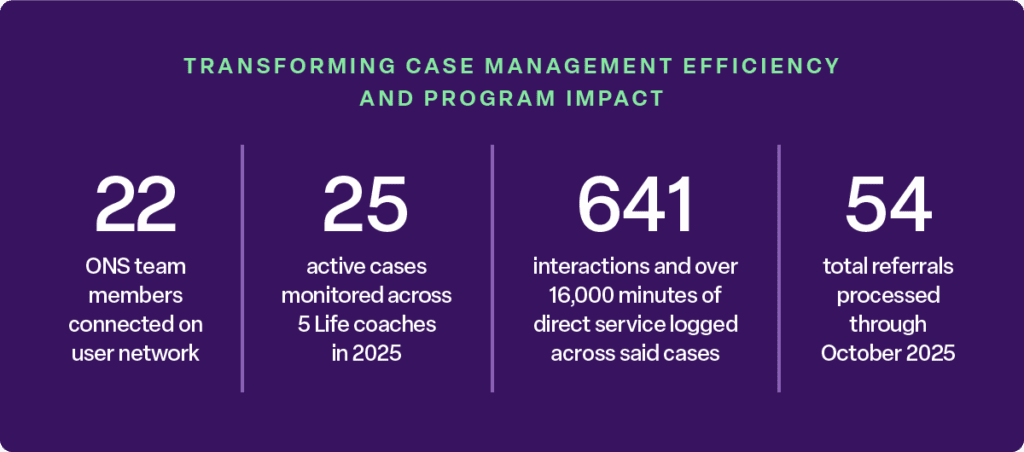
Since implementing Bonterra Apricot, ONS has fundamentally transformed its approach to case management and program evaluation. The platform provides comprehensive documentation capabilities that clearly demonstrate what ONS accomplishes for both the organization and individual program participants.
The centralized system eliminated previous communication inefficiencies by enabling streamlined information sharing across the entire 22-user network. The ONS team monitored 25 active cases across five life coaches in 2025, including the 641 interactions and over 16,000 minutes of direct service provided to those individuals through October 2025.
Apricot also simplified the team’s permissioning processes. Previously, admin users needed to email spreadsheet reports on a manual basis. Today, admins can easily grant licenses and view-only access across the department.
When staff members need to coordinate on shared cases or make calls regarding another team member’s clients, all necessary information is readily accessible within the platform. This collaboration enhancement has freed up significant time previously spent on internal coordination, allowing staff to focus conversations on improving participant experiences and program outcomes.
In particular, the ONS team has recently improved its processes for its life coaching services. Coaches are now provided with critical case information through Apricot, allowing them to tailor their programs to participant needs. Information recorded by the life coaches is also easily transferable to outreach specialists.
Apricot’s simple user interface proved valuable for Rachel and her team.
“We’re not developers or programmers, but we can easily set up a form in Apricot. We can modify templates or build new ones from scratch ourselves relatively easily. That was huge.”
The platform’s reporting capabilities support various stakeholders, from QA reports and caseload management to detailed financial tracking for services provided to clients over different timeframes. In addition to gaining the ability to track the volume of referrals the office receives (including the 54 it processed through October 2025), the team has also improved its model for prioritizing participants with urgent needs.
“Apricot has transformed our ability to identify high-priority referrals to our office. The information that we can now gather from form submissions is critical to this process. It simply wasn’t available through our previous system,” said Rachel.
The self-sufficiency matrix feature has particularly enhanced the team’s understanding of client needs, bringing a level of sophistication to their assessments that simply wasn’t available with their former systems. Government accountability requirements, such as tracking gift card distributions and usage verification for state auditor compliance, are now seamlessly managed through Apricot’s comprehensive process tracking capabilities.
Bonterra’s ASCs provided timely support throughout the office’s Apricot journey.
“The timing was on point. They helped get us set up, and then after we had been working in the system for a few months, we were able to partner with them again and dive into discussions about what needed to be added and what needed to be tweaked. That was really, really helpful,” said Faith.
Moving forward, ONS plans to expand Apricot access to additional contracted providers and leverage the platform’s capabilities to support their growing Familiar Faces program, further strengthening their community-centered approach to neighborhood safety and service delivery.




Work with Bonterra
Ready to drive more impact?