How Wesley Housing strengthened housing stability through centralized data

Overview

Supporting communities through data-driven insights.
Wesley Housing is a nonprofit affordable housing developer serving more than 4,700 residents across the Washington, D.C., and Virginia region. With a mission to improve the lives of their residents by creating and sustaining healthy communities, they manage 42 communities and provide comprehensive resident services. In addition to constructing affordable residential buildings, the organization also currently provides property management and resident services to members of its communities.
Wesley Housing focuses on four key impact areas, known as service pillars: Housing Stability, Community Engagement, Education, and Health & Wellness. To effectively manage these robust programs and demonstrate their value to funders, Wesley Housing needed a technology partner that could grow as its property acquisition strategy and programs expanded.
Customer profile
Product: Bonterra Apricot & Bonterra Success Services
Sector: Nonprofit
Vertical: Housing & shelter
The challenge
Prior to partnering with Bonterra, Wesley Housing struggled with disjointed data and labor-intensive reporting processes that made it difficult to see the full picture of their residential data and total impact.
Because of frustrations with a legacy system, resident services staff would often keep personal shadow lists and Excel spreadsheets at their desks to track their work. When it came time to report on results, managers had to email or call each resident services staff member to ask for updates, as the data was not present in the legacy system.
Once collected, managers would transfer data from the resident services staff to another document or spreadsheet, underscoring the inefficient nature of the data collection process. The data itself was also inconsistent from one staff member to another, and it was impossible to tell what might be duplicated, underreported, or missing altogether.
Christine Parker Hunt, the Senior Database Administrator at Wesley Housing, is responsible for system configurations and reporting at the organization. She recalled an early encounter she had with the paper-and-pen methodology that had been plaguing Wesley Housing’s data-sharing processes.
“I remember speaking to a specialist who tracked employment figures, and when I asked for the data, she said ‘Oh, it’s right here on my whiteboard!’ because that’s the way she tracked it,” said Christine.
The resident services team needed access to accurate occupancy data so they could begin assisting residents across a range of needs. They also needed to be able to track their service activities, such as referrals, service logs, progress notes, event attendance, and gift card distributions, as well as household needs, first engagement dates, engagement frequency, and service outcomes. These data points would capture the full picture of Wesley Housing’s level of support.
Unfortunately, obtaining accurate resident occupancy status data (across current and former residents) was a struggle for the team. Occupancy status data was not consistently entered into the legacy database, making it impossible to assess which residents were living in each property. The exact numbers of households and residents were largely unknown, and precise resident demographics could not be extracted.
The only way managers could pull household composition and demographics data was through RealPage, the property management software used by each of Wesley Housing’s communities. To view a property’s data, managers had to extract several property reports from RealPage and manually compare them to the data in the legacy system.
Aggregating service calculations was also a sluggish process. Creating a report with trends over time was not an option, as the data was not hosted in a single platform.
These data issues also impacted fundraising success.
On average, Wesley Housing’s fundraising team submits 150 reports annually. The team grew frustrated trying to source and interpret each property’s data, and they were also hesitant to rely on the limited information that was collected from the legacy system. Funders explicitly told the team that they were denied funding requests because of poor reporting in prior years.
Wesley Housing needed a solution that could automate these tasks, bridge the gap between property management data and service delivery, and provide the actionable insights required to secure funding and improve resident outcomes.
The solution
Recognizing the need for a sophisticated case management system that could handle complex reporting and integrate with their existing property management software, Wesley Housing turned to Bonterra.
The organization implemented Bonterra Apricot to centralize its data, enhance data quality, improve reporting, and streamline service delivery. By configuring Apricot to align with their specific program needs, Wesley Housing was able to create a single source of truth for resident data for both their fundraising and resident services teams.
In addition to transferring data from the legacy system to Apricot, Bonterra’s team developed a data integration with RealPage. This integration enabled automatic exports of resident and demographic data from RealPage to be imported into Apricot weekly. The enhancement reduced the number of hours Wesley Housing employees spent processing manual downloads while simultaneously improving the security of the organization’s resident data sharing.
With the new integration in place, Wesley Housing’s team members could run reports in Apricot that included new resident data with all of the necessary demographic information, as well as for former residents across all properties. This data was then used to update Apricot’s participant record, providing the resident services team with accurate resident information at their fingertips.
This integration was a key component of the organization’s effort to centralize data and improve data quality.
Christine could easily check the integration data at any time, thanks to the creation of a ‘staging area’ in Apricot. She could confirm or edit any new or former residents on demand, eliminating the time it took to log into RealPage and manually search across individual properties.
This improvement enabled Christine to dedicate time to making improvements to the organization’s reporting, which proved to be a worthwhile effort for multiple reasons.
Wesley Housing faced several reporting deadlines from government and private funders, as well as the organization’s own board of directors. These loomed on a monthly, quarterly, and annual basis. The fundraising team also made ad-hoc requests for analysis and demographic reports to improve proposals and support requests.
These reports required Wesley Housing’s team to aggregate activity counts across different types of services, such as housing stability, education, community engagement, and health & wellness, so that they could understand the areas of need being addressed by the resident services staff. As the volume of data uploaded to the system grew, so did the need for automated calculations.
Wesley Housing partnered with Bonterra Success Services to implement the aforementioned results reporting calculations. Two Advanced Support Consultants augmented Christine’s efforts by creating and maintaining calculations that proved essential to the organization’s ability to produce quality reports in a timely fashion.
Because Wesley Housing receives funding based on geographical data, the ability to run these calculations for specific properties, regions, users, or across the total portfolio was essential.
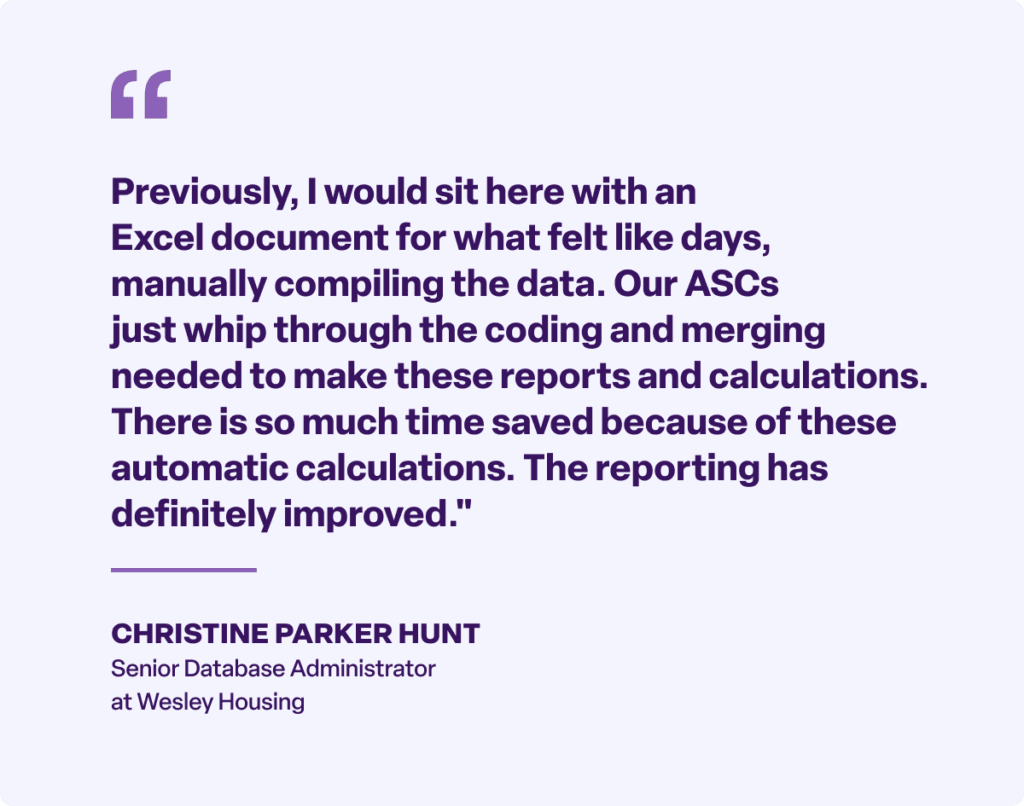
“Our ASCs were critical to building the calculations and a collection of very powerful automated reports that I rely on daily. I can run a report for resident demographics, service types, and quantities of service activities instantly,” said Christine.
Outcomes
With Bonterra Apricot in place, Wesley Housing has elevated its ability to measure success and expanded the team’s overall capacity.
By combining property management data with service delivery metrics, the organization can now draw direct lines between its interventions—such as employment assistance or rent relief—and positive housing outcomes like eviction prevention. They can also easily identify data gaps and low-output regions, allowing them to quickly address missing values in the system. The team can now track year-over-year data and evaluate trends because of the consistent, high-quality data housed in Apricot.
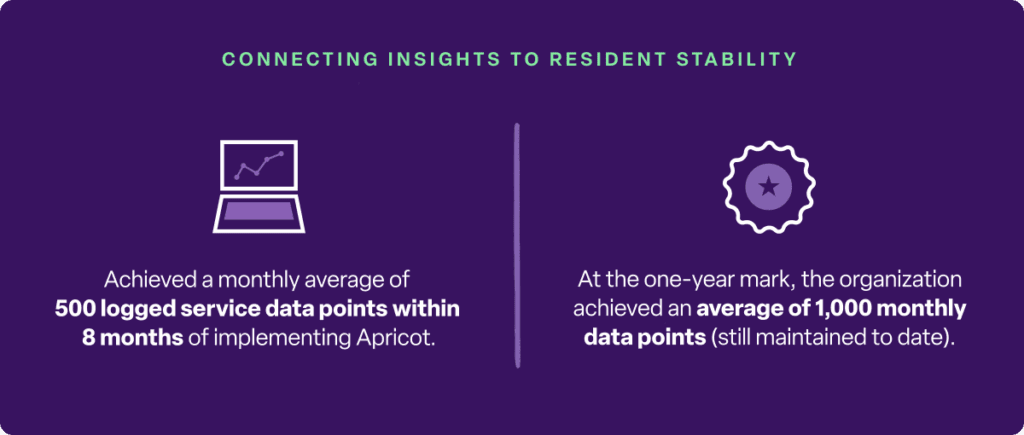
Within 8 months of implementing Apricot, Wesley Housing achieved a monthly average of 500 logged service data points per property. At the one-year mark, that number had risen to 1,000 data points.
This visibility has fundamentally changed how the team operates.
Wesley Housing’s fundraising team took advantage of the easily accessible and enhanced data, leveraging Apricot to quickly add compelling data to grant reports and proposals, significantly reducing the time required to prepare submissions. The team’s dedicated grant writer, who previously had to support the manual data sourcing and reporting workflow, can now focus significantly more time on the grant writing process.
For Christine and the resident services team, the time saved has empowered them to engage in higher-value, higher-impact activities, such as improving Apricot workflows and leveraging some of its inherent automations.
Specifically, Christine configured alerts that automatically trigger notification emails for volunteer application submissions, duplicative data point entries, form completions, and upcoming deadlines.
Wesley Housing’s collaboration with Bonterra Success Services resulted in key time-saving benefits, freeing up Christine to prioritize projects with support from multiple pro bono partners. Christine worked with instructional design consultants to create a new e-learning training program for her staff. She also partnered with data engineers to leverage data from RealPage and Apricot to conduct a deeper analysis of the reasons individuals leave Wesley Housing’s properties.
“Their support has been essential to our success,” said Christine.
“We don’t have all of the answers yet, but this new work is a good use of my time. I’m no longer calculating how many attendees participated in an event by hand. I’m working with the data engineers to look across our RealPage and Apricot datasets, put them together, and learn about our outcomes at a higher level.”




Work with Bonterra